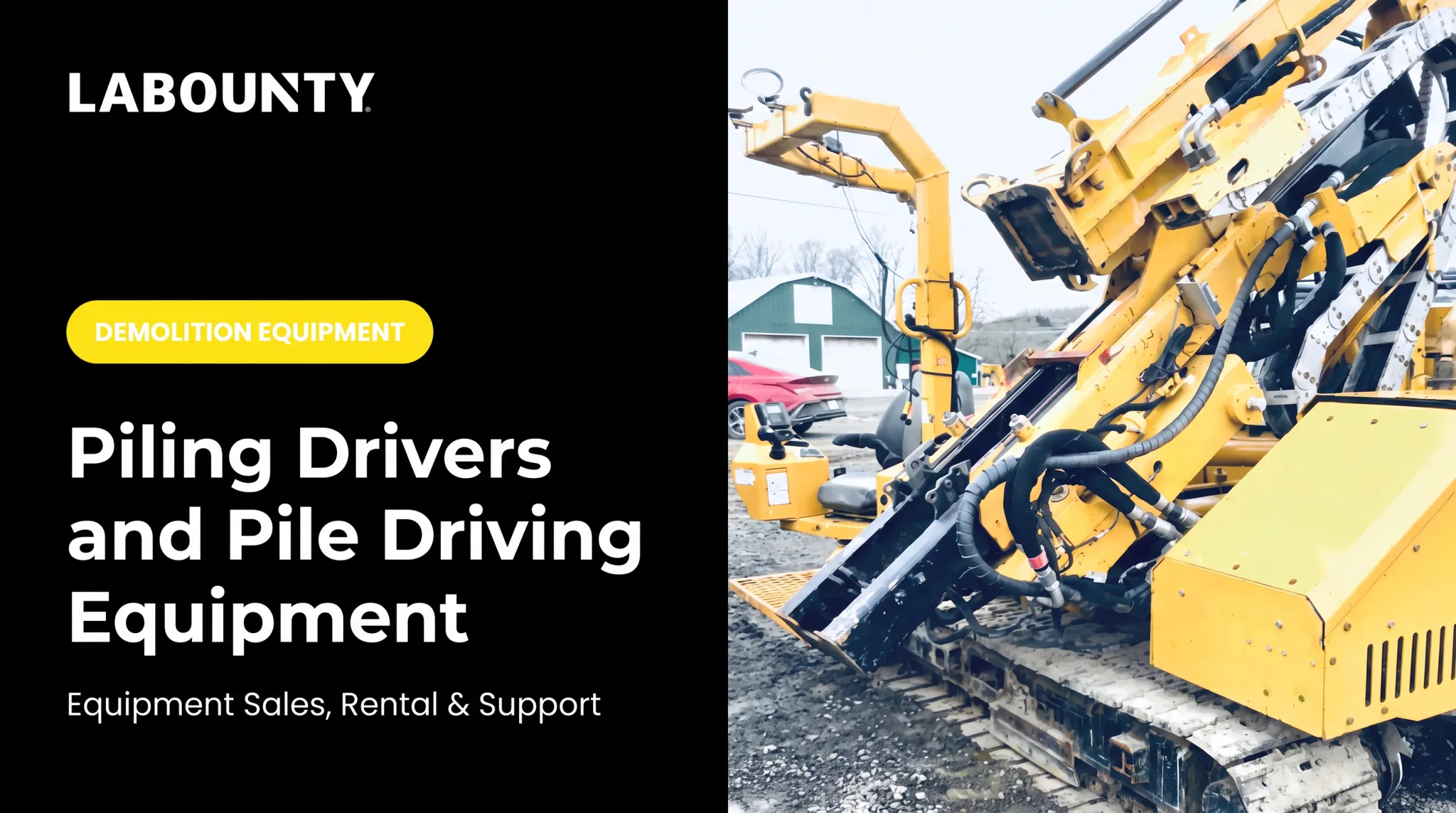

Introduction
Foundation work next to a hospital, a century-old brick facade, or a live sewer line doesn't leave much room for error. Impact hammers shake the ground. Vibratory drivers rattle nearby structures. Neither is a good neighbor.
The Federal Transit Administration lists 0.12 inches per second peak particle velocity as its assessment criterion for buildings extremely susceptible to vibration damage. That category includes fragile historic structures.
That's the kind of number that shuts down conventional pile driving before it starts, according to the FTA's Transit Noise and Vibration Impact Assessment Manual.
Hydraulic press-in pile drivers offer a different approach. Instead of striking piles, they push them into the ground using sustained hydraulic force. This guide covers how the system works, where it fits, how to select the right equipment, and where its limits are.
Key Takeaways
- Press-in drivers use continuous force and reaction, not impact energy like a hydraulic hammer.
- Low noise, low vibration, controlled alignment, and less pile-head shock on tight urban sites.
- Machine selection hinges on pile type, soil conditions, required press-in force, reaction capacity, and site access.
- Geotechnical review, manufacturer specs, and operator training are non-negotiable before mobilization.
What Is a Hydraulic Press-In Pile Driver?
A hydraulic press-in pile driver, sometimes called a hydraulic static pile driver or static pile pressing machine, advances piles through hydraulic cylinders rather than a falling ram. It's a different tool from a hydraulic impact hammer, even though both run on hydraulic power.
Static Pressing vs. Impact Hammers
An impact hammer lifts a weight and drops it, transferring blow energy into the pile head. A press-in rig does the opposite: it clamps the pile and applies steady, controlled force until the pile advances. No shock, no cyclic loading, no hammering noise.
Manufacturer documentation from Giken, one of the industry's most established press-in equipment makers, describes the mechanism plainly. Clamps grip previously installed piles for reaction while hydraulic rams push the next pile into the soil (Giken's press-in principle overview).
Pile Types and Reaction Force
Press-in systems are typically matched to specific pile geometries, including:
- U- and Z-shaped sheet piles
- Steel pipe piles (some machines use rotary-cutting variants)
- H-shaped sections, depending on the chuck configuration
That reaction force matters more than most contractors expect. The machine doesn't push against thin air. It grips already-installed piles and uses their resistance to extraction as a counterforce. Before enough piles are in the ground to provide that reaction, crews need a starting stand and counterweights instead.
Separately, "hydraulic" only describes power transmission—not one fixed machine layout. Press-in equipment comes as dedicated rigs, modular units, or attachments. Confirm compatibility with a given pile section against the manufacturer's specifications rather than assuming a fit.
How Does a Hydraulic Press-In Pile Driver Work?
A hydraulic press-in pile driver clamps onto a pile and pushes it into the ground with sustained hydraulic force. Reaction comes from already-installed piles or a starting stand, so the machine can advance along the line without impact blows.
The Installation Sequence
A typical press-in cycle runs through a repeatable pattern:
- Survey and position the pile at the planned location and alignment.
- Clamp the incoming pile in the machine's chuck.
- Press using hydraulic rams, driving the pile downward.
- Release and re-grip as needed to continue the stroke.
- Advance the machine along the completed pile line for the next installation.

Hydraulic pumps, cylinders, valves, clamps, and guide systems coordinate each stroke. Exact pressure and capacity figures vary by model, so pull those numbers from the manufacturer's spec sheet rather than a general estimate.
Operators rely on mast or leader guides, clamp adjustments, and regular survey checks to hold verticality as the pile advances. Pressure readings and penetration rate give real-time feedback on ground resistance, which helps flag abnormal conditions or approaching refusal before it becomes a problem.
Insufficient reaction capacity is one of the most common failure points. Without enough resistance from installed piles or a properly weighted starting stand, the machine can experience uplift, clamp slippage, or lost alignment mid-press.
Static Pressing vs. Impact and Vibratory Driving
| Method | Force application | Noise/vibration profile | Site fit |
|---|---|---|---|
| Static press-in | Sustained hydraulic force, no blows | Below 75 dBA at 5 m (~16 ft) in one field study | Best for vibration-sensitive, occupied, or historic areas |
| Impact driving | Repeated ram strikes | 0.644 in/s PPV at 25 ft (FTA source level) | Faster in favorable ground; higher disturbance risk |
| Vibratory driving | Cyclic oscillation | Much higher vibration than static at the same site | Efficient in loose to medium soils; less suited near fragile structures |
These figures come from different sites and test conditions, so treat them as directional evidence of mechanism differences, not a guaranteed percentage reduction for every job.
Auxiliary Techniques for Difficult Ground
Water jetting can reduce shaft and interlock friction by raising pore-water pressure near the pile toe. Pre-drilling helps in dense or obstructed layers. Both require geotechnical sign-off, since they can affect soil support conditions, environmental controls, and the pile's final load capacity.
Benefits and Applications of Hydraulic Press-In Pile Drivers
Where Low-Noise Installation Matters Most
Static pressing earns its keep on sites where conventional driving would trigger complaints, permit denials, or actual structural risk:
- Hospitals, schools, and other occupied buildings nearby
- Historic or fragile masonry structures
- Utility corridors and buried services
- Urban retaining walls, cofferdams, and waterfront construction
Manufacturer project records document press-in work beside a live sewer line just 12 inches from the sheet-pile alignment. Another records a seawall installed next to residential homes. Both are useful feasibility examples, not a substitute for independent noise testing on your own site.
Controlled Force, Fewer Surprises
Because the pile advances under steady pressure rather than repeated shock, there's less risk of:
- Pile-head damage from hammering
- Interlock damage on sheet piles
- Excessive deflection during installation
- Disturbance to adjacent ground
That said, results still depend on correct machine setup, proper pile selection, and adequate reaction capacity. The equipment doesn't compensate for a poor match between machine and ground conditions.
Known Limitations
Static pressing isn't a universal fix. It runs into trouble with:
- Very hard strata, boulders, or rock without specialized augering equipment
- Insufficient reaction support during early installation
- Certain restricted pile profiles that don't fit the chuck
- Slower progress in some soil types compared to impact methods
In many projects, static pressing works alongside other methods rather than replacing them entirely. Crews pair it with pre-drilling, casing, or water-jet assistance depending on what the ground demands.
How to Choose the Right Hydraulic Press-In Equipment
Confirm Project Inputs First
Before evaluating machines, lock down the basics:
- Geotechnical report, soil layers, and groundwater conditions
- Design depth, pile type, and dimensions
- Required capacity and installation tolerances
- Site access, headroom, and proximity to existing structures
Match Machine Capability to Conditions
Once those inputs are confirmed, compare the machine's rated press-in force, clamp configuration, reaction capacity, hydraulic flow, and lifting capability against the project's actual demands. Pay close attention to pile-specific factors:
- Sheet-pile interlock type and pipe-pile diameter
- H-pile geometry and length, including extension joints
- Pile-head protection during clamping
- Whether the chuck can release and re-clamp without damaging the pile
Buy, Rent, or Subcontract
Total project cost tells a more accurate story than sticker price alone. Factor in transport, setup, lifting support, operator training, hydraulic power supply, maintenance, and downtime risk.

Here's a quick decision checklist for when static press-in makes sense:
- Noise and vibration limits are tight → static press-in is usually favored
- Ground includes boulders or rock → pre-drilling or an integral-auger configuration may be needed instead
- Access is limited or headroom is low → confirm the specific machine's operating envelope, not a generic spec sheet
- Reaction capacity from prior piles is uncertain → plan for a starting stand and counterweights
EFI Demolition Equipment does not currently stock dedicated press-in pile drivers. That gap is worth knowing before you plan procurement around their yard.
Where EFI does help is rentals, delivery, job-ready gear, and custom-fabricated mounts and pins when the machine-and-attachment fit matters.
If the job shifts to impact driving, EFI's hydraulic hammer lineup runs from units like the 2020 Mustang HM1300 at 1,770 ft-lbs for 7-17 ton excavators up to heavier options such as the 2017 Paladin SFB12K at 12,000 ft-lbs.
Get a manufacturer or engineer review before you buy or rent. Confirm OSHA requirements and local permitting before mobilization.
Safety, Monitoring, and Maintenance Essentials
Pre-Operation Checks and Operating Practices
Before any press-in cycle begins, inspect hydraulic hoses and fittings, clamps, guides, structural members, guards, and emergency-stop functions. Confirm pile alignment and reaction support are adequate for the planned sequence.
During operation:
- Establish exclusion zones around suspended loads
- Verify ground bearing capacity beneath the machine
- Maintain clear communication between operators and ground crew
- Stop immediately if the pile shifts, the clamp slips, pressure changes unexpectedly, or structural movement occurs
OSHA's pile-driving equipment standard, 29 CFR 1926.603, addresses operator overhead protection, equipment stabilization, and keeping employees clear while piles are hoisted into position. Apply the provisions relevant to the specific machine and lifting operation you're running, not a blanket hammer-focused checklist.
Maintenance and Capacity Records
Routine maintenance should follow the equipment manual's service intervals. Cover at least:
- Hydraulic fluid and filter checks
- Leak inspection
- Clamp and guide wear
- Cylinder seals
- Sensor calibration
Pressure readings alone don't prove pile capacity. Installation-force data, survey observations, and engineer-approved acceptance criteria all need to factor into final sign-off. Keep those records separate from your project's formal load-testing results.
Contractors running press-in or impact equipment can turn to EFI Demolition Equipment for parts, repair support, and operator training. Confirm coverage for your specific piling setup before you schedule service.
Frequently Asked Questions
What is a hydraulic piling rig?
A hydraulic piling rig uses hydraulic power to install piles, but configurations vary widely. Static press-in rigs apply sustained clamping force, while hydraulic impact hammers lift and drop a ram. Capacity and setup depend on the pile type and project.
How does a hydraulic press work?
Hydraulic pumps send pressurized fluid to cylinders, generating controlled linear force through clamping and pressing action. This static force is different from the sudden impact energy created by a falling ram.
Can an excavator be used to drive piles?
Some excavators can run piling attachments designed for that purpose, but a standard excavator isn't automatically suited for static press-in work. Hydraulic flow, lift capacity, stability, and attachment compatibility all need engineering review first.
What is the difference between a hydraulic press-in pile driver and a hydraulic impact hammer?
A press-in driver applies continuous static force through clamping and hydraulic rams. An impact hammer delivers repeated blows through a falling ram. The difference shows up in noise, vibration, pile stress, and which sites each method suits.
When should a contractor use a hydraulic press-in pile driver?
Static press-in fits best on vibration-sensitive or noise-restricted sites with compatible pile profiles and soil conditions, provided adequate reaction capacity exists. Project-specific geotechnical and engineering confirmation is still required before mobilizing.