
Introduction
Weak or unstable soil near the surface can't always carry a structure's load on its own. Deep foundations solve that problem by transferring weight through loose fill, soft clay, or fluctuating groundwater down to a competent bearing layer. They can also generate enough friction resistance along the pile shaft.
A pile driver is a complete system: hammer, carrier, leads, driving cap, cushions, clamps, and power source. The right combination depends on pile material, soil profile, required capacity, site access, target depth, and environmental restrictions.
This guide breaks down how pile drivers work and the major equipment categories available. It also explains how to match equipment to a project and which installation risks and cost factors matter on U.S. construction sites.
Key Takeaways
- Equipment selection depends on pile type, soil conditions, target depth, and site access, not hammer size alone.
- Impact, vibratory, press-in, and drilling-assisted methods differ sharply in speed, noise, vibration, and pile performance.
- Geotechnical data and manufacturer specs, not guesswork, guide final equipment decisions.
- Total project cost includes mobilization, labor, tooling, maintenance, and testing, not just the rental rate.
What Is a Pile Driver and How Does It Work?
A pile driver system is a set of parts that work together to place foundation piles:
- Pile — the structural element being driven
- Hammer or driver — generates impact, vibratory, or static force
- Carrier — crane, excavator, or dedicated rig
- Leads — guide alignment during driving
- Driving cap or helmet and cushions — protect the pile head
- Clamps and power source — hold vibratory heads and supply diesel, hydraulic, or pneumatic power
Basic Installation Sequence
Installing a pile generally follows the same pattern regardless of method:
- Position and align the pile at the correct location and angle.
- Secure it in the leads or clamp.
- Apply force: impact, vibration, or hydraulic pressing.
- Monitor penetration rate, blow count, and alignment continuously.
- Verify against the installation criteria set by the project's engineer.

Impact, Vibratory, and Press-In Mechanics
Impact hammers deliver repeated blows through a ram and driving assembly. Common types include:
- Gravity (drop) hammers — release a lifted ram
- Single-acting air or steam hammers — use pressurized fluid to lift the ram
- Double-acting hammers — add pressure on the downstroke as well
- Hydraulic hammers — same cycle, powered by an external hydraulic source
- Diesel hammers — rely on combustion; stroke and energy vary with operating conditions
According to the Federal Highway Administration's guidance on driven pile foundation design and construction, the full driving assembly (hammer, helmet, cushions, and pile) must be evaluated as one system. Energy lost through cushions changes how much force reaches the pile tip.
Vibratory drivers use a hydraulically clamped head that transmits continuous oscillation instead of discrete blows. That reduces side friction so the pile advances under its own weight plus the vibratory force. Equipment classes range from roughly 1,200 vibrations per minute for low-frequency units up to 2,300–2,400 for high-frequency, variable-moment machines.
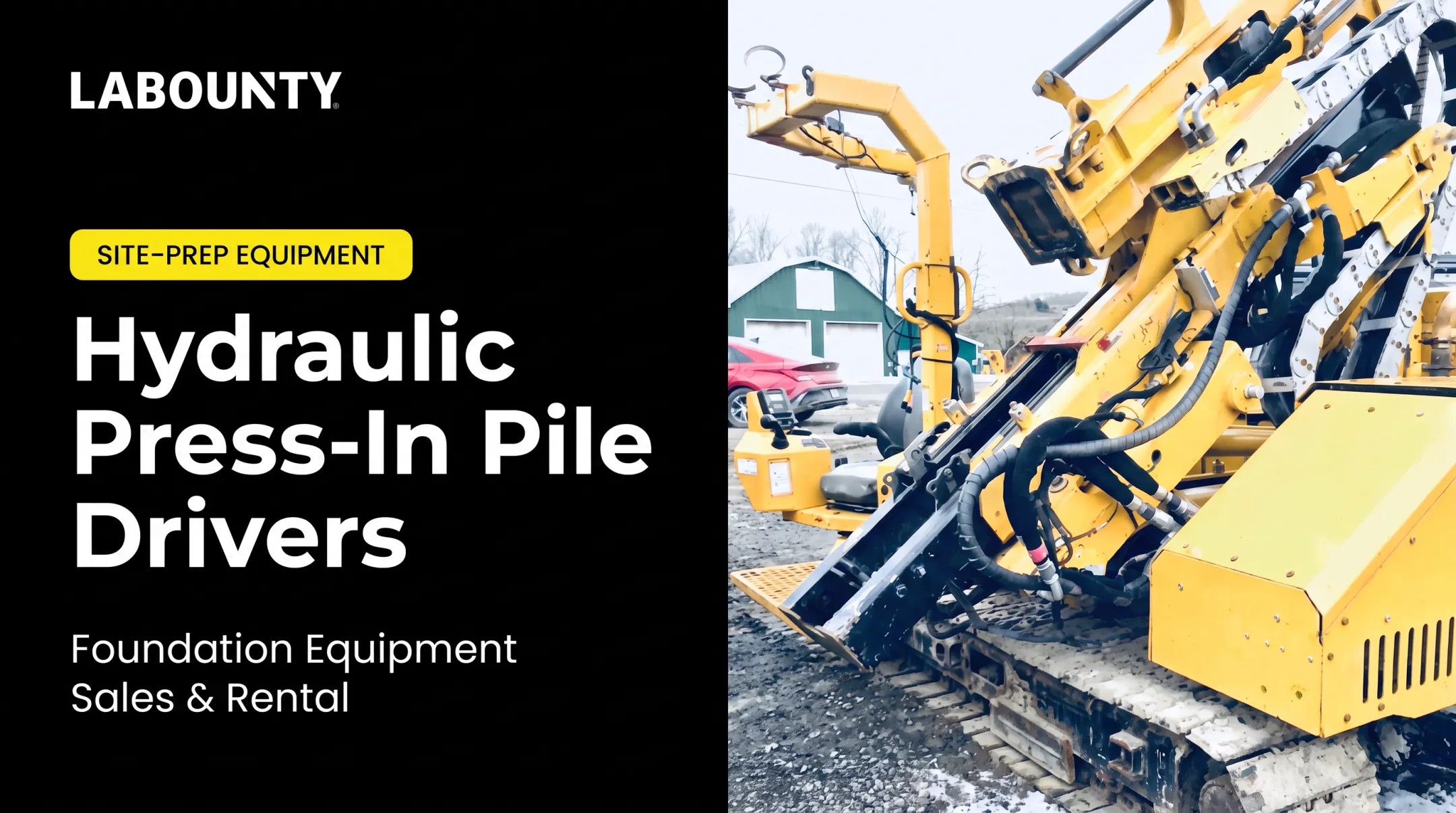
Press-in systems skip vibration and impact entirely. Hydraulic rams jack the pile down while clamps grip previously installed piles and use their resistance as the reaction force.
Blow counts, driving resistance, and penetration rate are field observations, not proof of capacity. Only the project's geotechnical and structural engineers can interpret those numbers against the design requirements.
Types of Piling Equipment and When to Use Them
Different installation methods suit different soils, noise limits, and pile types.
| Method | How it works | Noise/vibration profile | Best suited for |
|---|---|---|---|
| Impact hammer | Repeated ram blows through cushions | Short, high-amplitude events | Dense soils, high-capacity piles |
| Vibratory hammer | Continuous clamped oscillation | Sustained vibration, can approach impact levels | Sandy/granular soils, sheet piles |
| Press-in (silent piling) | Hydraulic jacking against reaction piles | Substantially lower vibration | Urban sites, sensitive structures |
| Drilling-assisted/pre-augering | Predrilling loosens soil or clears obstructions | Varies by method | Boulder zones, dense strata |
A common assumption is that "vibratory" means "vibration-free." It doesn't. Caltrans' construction vibration guidance notes that sustained vibratory driving, particularly during start-up and shutdown resonance, can produce ground vibration amplitudes comparable to impact driving. In contrast, static hydraulic press-in systems generate substantially less vibration than either conventional impact or vibratory equipment.
Carriers and Power Sources
Carrier choice affects reach, mobility, and setup time:
- Excavator-mounted rigs offer mobility and quick repositioning for smaller piles and sheet piling.
- Crane-suspended hammers handle heavier piles and deeper installations.
- Leader-rig and purpose-built piling machines provide precise alignment control for high-volume or high-tolerance work.
Site access, ground-bearing capacity, and pile length typically decide which carrier fits a given job. Power source matters too: diesel units offer independence from external power but come with emissions considerations under EPA nonroad engine standards, while hydraulic and electric options reduce noise and emissions on sensitive sites, an increasingly common requirement near residential or environmentally sensitive job sites.
Pile Types and Supporting Gear
Steel sheet piles, H-piles, pipe piles, timber, and precast concrete each respond differently to hammer selection based on cross-section, stiffness, and head condition. Sheet piles are commonly driven with vibratory equipment; heavier displacement piles often call for impact hammers.
Supporting accessories matter as much as the hammer itself: leads, templates, helmets, cushions, clamps, power packs, compressors, and extraction tools all affect how cleanly a pile goes in and comes out, if needed.
For smaller-diameter foundation work, augering can assist or substitute for driving. EFI Demolition Equipment's rental catalog, for example, includes the 2024 LYALS LY8000N excavator auger, built with a 3-inch drive shaft and 12-inch or 16-inch bits, configured for excavators in the 12,000–40,000-pound range for drilling foundation holes and soil boring.
Pre-augering, jetting, or casing can help pass obstructions or dense layers, but these methods change soil behavior around the pile and require engineering approval before use.
How to Choose the Right Pile Driving Equipment
Equipment selection starts long before a hammer shows up on site.
Start With the Project Brief
Define the essentials first:
- Pile purpose (bearing, retaining, temporary, or non-load-bearing)
- Pile type, dimensions, and target depth
- Installation tolerances and production schedule
Match Equipment to Soil and Geotechnical Data
Loose granular soils, stiff clay, layered strata, gravel, rock, groundwater, and obstructions all change how a pile behaves under load. Current borehole or site-investigation data, not assumptions, should inform hammer selection.
Manufacturer energy ratings, frequency, clamp capacity, and rated operating limits matter. A proper driveability analysis (matching hammer, pile, cushion, and soil inputs) tells you far more than advertised power alone.
Assess Site and Environmental Constraints
Before committing to equipment, check:
- Overhead clearance and access roads
- Working platform stability
- Proximity to buildings, utilities, and waterways
- Noise, vibration, and emissions limits near hospitals, historic structures, or sensitive equipment
- Local permitting or monitoring obligations
Compare Ownership, Rental, and Subcontracting Costs
Total cost of operation includes mobilization, operator requirements, fuel or power packs, tooling, maintenance, testing, standby time, repairs, and removal. A lower daily rental rate doesn't help if mobilization and downtime eat the savings.
This is where sourcing flexibility helps. EFI Demolition Equipment supplies new and used units, including solar pile drivers with auto mast-leveling, auto plumb, GPS-based placement by location and depth, and dual joystick controls. Wide track pads limit jobsite disturbance from soft soil to rocky ground.

Contractors comparing attachment-mounted or specialized equipment can ask EFI about sourcing, fitment, custom-fabricated mounts and pins, inspection, rental, and parts support. EFI doesn't provide engineering design or pile-driving certification; that call stays with your geotechnical and structural engineers.
Installation Planning, Safety, and Common Problems
Getting piles in the ground safely takes planning before the first blow ever lands.
Pre-Installation Checklist
- Review engineering documents and confirm target depths and criteria
- Confirm underground hazards, utilities, and site access
- Prepare a stable working platform
- Inspect the hammer, carrier, and rigging
- Establish alignment controls and crew communication protocols
- Brief the crew on exclusion zones
Safety Requirements
Qualified operators, manufacturer operating instructions, and site-specific hazard assessments are the baseline on every job.
Under 29 CFR 1926.603, OSHA requires:
- Overhead protection for operators
- Lead stop blocks
- A hammer-support blocking device whenever employees work beneath the hammer
- Clearance from the leads while a pile is hoisted
Hearing and eye protection, suspended-load controls, and safe separation distances round out the basics.
Common Field Problems
Even well-planned jobs run into surprises:
- Excessive blow counts or unexpectedly easy driving compared to predictions
- Refusal before reaching target depth
- Pile deviation or head damage
- Cracked concrete piles
- Obstructions or movement of adjacent, already-installed piles
When any of these show up, pause work, then:
- Check equipment setup and cushions
- Verify alignment
- Review the soil data
- Document what happened
- Bring in the geotechnical or structural engineer
A quick field fix should never substitute for engineering review.
Environmental Controls
Noise, vibration, dust, and fuel or hydraulic leaks all need active management, especially near sensitive structures. Monitoring thresholds and permitted limits vary by project and jurisdiction, so check the applicable local requirements rather than assuming a standard number applies everywhere.
Frequently Asked Questions
How much does it cost to drive pilings?
There is no reliable generic per-pile price. Cost depends on pile type, depth, soil conditions, driving method, site access, labor, mobilization, testing, and whether you rent or own the equipment—so get a project-specific estimate.
How does a pile driver work?
Impact, vibration, or hydraulic pressing transfers force to advance the pile into the ground. A carrier, leads, driving cap, and cushions control alignment and manage how energy transfers into the pile.
What is a pile driver in construction?
A pile driver is the equipment system that installs piles into soil so foundations, retaining structures, marine works, and transportation projects can transfer loads deep below grade.
What equipment is used for piling?
Primary machines include impact and vibratory hammers, press-in rigs, and carriers such as cranes, excavators, or leader rigs. Supporting gear covers helmets, cushions, clamps, power packs, compressors, templates, and drilling or extraction tools.
What is the difference between an impact hammer and a vibratory pile driver?
Impact hammers deliver repeated blows to drive the pile; vibratory drivers use continuous oscillation to reduce soil resistance around the shaft. Soil type, pile type, capacity needs, and noise or vibration limits determine which fits better.
How do I choose the right pile driving equipment for my project?
Evaluate geotechnical conditions, pile specifications, required capacity and depth, site access, environmental limits, and production schedule. Weigh total cost next, and confirm the setup with qualified engineers and equipment specialists.