
Contractors making equipment decisions need to weigh tree and brush size, acreage, terrain, soil conditions, the finish the client wants, how debris will be handled, and budget. Each of those factors points toward a different carrier and attachment combination.
This guide breaks down how to match tasks to tools, size a carrier correctly, sequence the work safely, and decide whether to buy, rent, or configure equipment for the job ahead. The goal isn't finding the biggest machine on the lot. It's finding the right one.
Key Takeaways
- Match tools to vegetation: mulchers for standing growth, pullers for roots and stumps, grapples for debris.
- Verify attachment weight, hydraulic flow, and reach fit the carrier's approved operating range.
- Large or mixed-terrain sites need several machines in sequence, not one universal solution.
- Build in utility locating, erosion control, and permitting checks before equipment reaches the site.
Match Forestry Land Clearing Equipment to the Task
The material you're clearing decides the tool. Light brush, mature trees, stumps, roots, rock, and slash each call for different cutting action, weight, and reach.
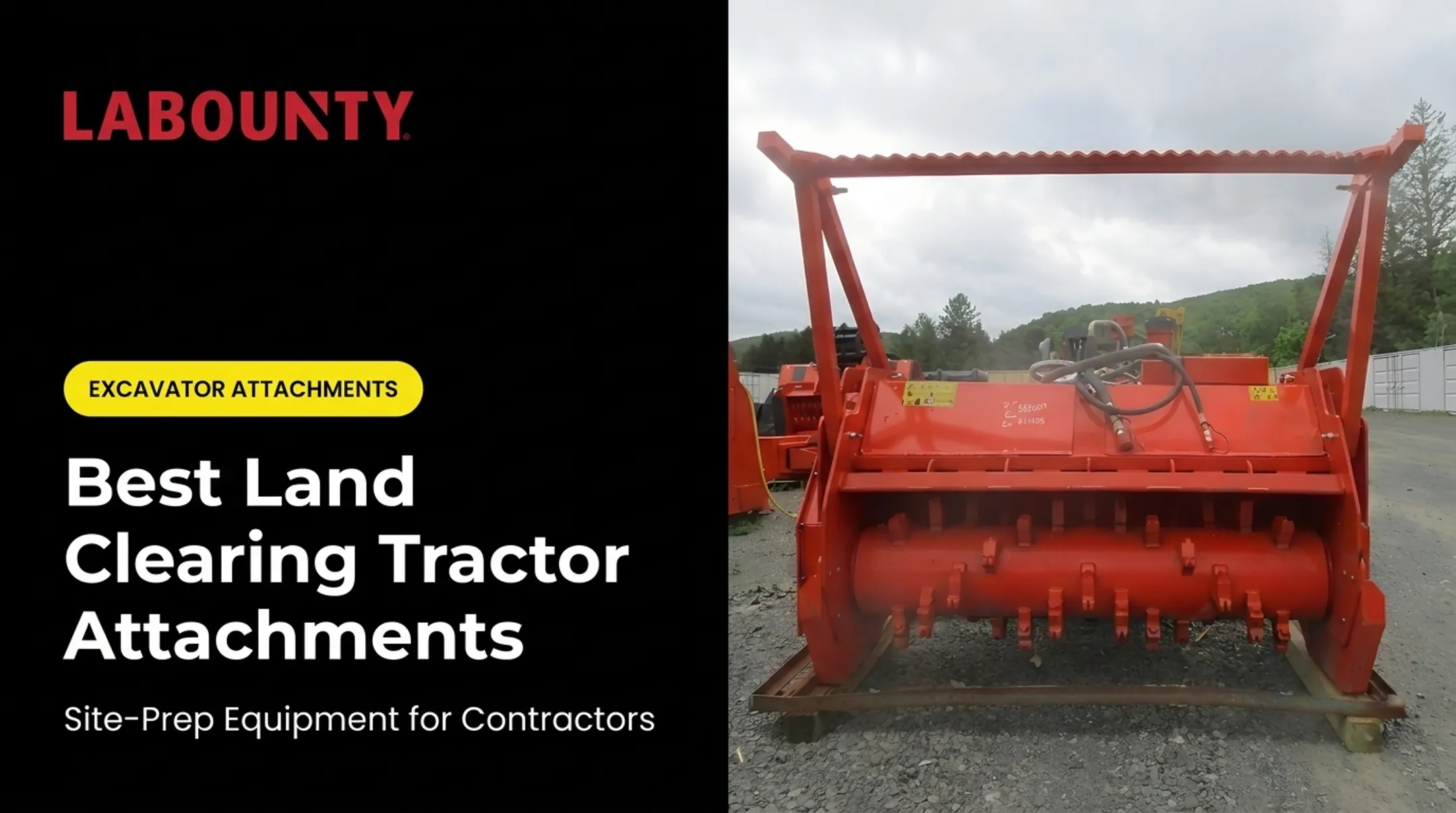
Mulching Heads: Drum, Disc, and Deck
Forestry mulchers process vegetation in place, but the head style changes the outcome:
- Drum heads use a rotating tooth drum to produce a finer, more consistent mulch, the choice when particle size and finish matter most.
- Disc heads spin fixed teeth for fast reduction and felling, leaving a coarser finish than a drum.
- Deck heads rely on a blade-driven design built for quickly cutting dense, smaller brush.
A disc head like Fecon's Disc Hawk can fell trees up to 14 inches, but that's a felling rating, not a promise of fine mulch on material that size.
For skid-steer mulching, match cutting width and carrier capacity. EFI's 2023 HANDY HBDM72 runs a 6-foot cutting width for tree and branch grinding, and fits any brand skid steer that can handle 2,585 lbs.
Cutters, Saws, and Excavator Attachments
Brush cutters, rotary cutters, and flail mowers each have their own diameter limits. Always confirm the model's rated cut in the manufacturer data, not the category name. A tree saw, by contrast, fells a standing trunk rather than mulching it in place.
For selective work, excavators equipped with the right attachment handle jobs a mulcher can't:
- Grapples grasp and sort stems, logs, and brush.
- Hydraulic thumbs pin irregular material against the bucket.
- Tree pullers extract small trees or full root systems.
- Root rakes separate surface roots and debris from soil.
EFI's used ALPINE TC-E2 rotary cutter, for example, weighs 6,500 lbs and fits 40,000–140,000 lb excavators — a reminder that attachment weight has to match the carrier class, not just the job type.
Stumps, Loaders, and Final Shaping
Stump grinders and stump pullers solve different problems:
- Grinders process the stump below grade and leave the root ball in place.
- Pullers extract stump and roots together, but disturb more soil.
Once material is down, loaders and grapples take over collection and hauling. EFI's 2018 SEC 42-inch bucket grapple weighs 2,775 lbs and fits 30,000–90,000 lb excavators. The 2022 JISAN JXJMQC315 grapple is a 12–18 ton unit priced at $6,100. Both are built for sorting and loading, not cutting.

Dozers and grading attachments belong at the end of the sequence for pushing, windrowing, and rough-shaping the site, not as a first-choice tool for standing timber.
How to Choose the Right Carrier Machine and Attachment
Choosing a carrier starts with the job, not the horsepower rating on the spec sheet.
| Carrier | Best for | Watch out for |
|---|---|---|
| Excavator | Reach, breakout force, controlled selective removal | Attachment weight and hydraulic flow must match the exact model |
| Skid steer / CTL | Maneuverability, quick attachment changes | May lack the hydraulic package a heavier head needs |
| Dozer | Pushing, rough grading | Not built for selective stem or stump extraction |
| Wheel loader | Loading and moving cleared material | Limited reach for standing vegetation work |
Sizing the Carrier Correctly
An excavator sized for forestry work needs its operating weight, lift capacity, hydraulic flow and pressure, and boom/stick reach checked against the attachment manufacturer's approved range. Do not assume a match.
FAE, for instance, rates its BL2/EX/VT excavator mulcher for 8–14 metric-ton carriers running 26–37 GPM, handling trees up to 6 inches. That's a specific pairing, not a universal setting for every mulcher head.
Standard Flow vs. High Flow
Hydraulic mismatch is one of the fastest ways to damage an attachment or waste money on one that underperforms. Bobcat publishes standard-flow loader ranges of 17.6–23.6 GPM at 3,500 PSI, with high-flow configurations reaching up to 36.6 GPM. Bobcat specifically identifies mulchers and stump grinders as high-flow applications.
Too little flow slows rotor speed and cutting performance. Too much flow or pressure risks damaging components that weren't built for it. Always check the exact model's hydraulic requirements before pairing carrier and head.
Ground Conditions Change the Equation
Compact track loaders spread weight over a wider contact area, giving better flotation on soft ground. Wheeled skid steers move faster and turn more easily on firm surfaces but sacrifice that flotation advantage. Neither claim tells you the safe operating slope for a specific site. That comes from the machine's own operating manual and a real site assessment.
Closing Compatibility Gaps
Custom-fitted attachments help close gaps when the carrier and head don't line up out of the box. EFI's custom metal fabrication shop builds mounts and pins in any size, with most jobs turned around in one to three days. Engineering and hydraulic compatibility still need confirmation before the machine goes to work.
Plan the Clearing Sequence and Manage Safety
A practical clearing sequence looks roughly like this:
- Survey the property — mark utilities, protected trees, and sensitive areas.
- Establish access and exclusion zones for equipment and bystanders.
- Cut or mulch standing vegetation with the selected head.
- Handle logs and slash — stack, chip, or haul depending on the debris plan.
- Remove stumps and roots using a grinder or puller as appropriate.
- Grade, stabilize, or restore the site for its next use.

Jobsite Safety Controls
Before cutting starts, lock in the basics: pre-start inspections, proper guarding, PPE, and machine-specific training.
Key controls on forestry clearing jobs:
- Maintain manufacturer exclusion zones for falling trees, thrown debris, and rollover risk
- Keep bystanders well outside those distances (often farther than typical jobsite habits)
- Inspect hydraulic lines carefully; never check for a leak by hand under pressure
Environmental and Permitting Checks
Build erosion, sediment, waterway, and dust controls into the plan before equipment mobilizes. Confirm burning, stormwater, and local clearing rules for the specific jurisdiction; there is no single nationwide rule for every site.
Common federal triggers to check early:
- Construction-stormwater (NPDES) coverage when clearing or grading disturbs 1 acre or more, including smaller parcels in a larger common plan
- Section 404 dredge-and-fill review when wetlands or waters of the U.S. are involved
Decide debris handling up front: mulch in place, chip and haul, salvage timber, or dispose under local rules. That choice drives which machines and attachments you bring to the site.
Buy, Rent, or Configure Forestry Land Clearing Equipment
Match the acquisition path to how often you clear and what your carrier can run:
- Buy a compatible carrier and head when clearing work is steady and recurring
- Rent a specialized saw or grinder needed for a single job
- Configure custom mounts and pins when a stock attachment will not fit the carrier you already own
- Subcontract niche tasks that neither owned nor rented equipment covers
What to Check Before You Buy or Rent
- Service history and inspection records
- Undercarriage or tire condition
- Hydraulic leaks and hose condition
- Attachment wear on teeth, blades, pins, and bushings
- Guarding and coupler fit
- Replacement-part availability
A supplier that matches equipment to the actual job, not just what sits in stock, makes a bigger difference than most contractors expect. EFI Demolition Equipment works this way: every unit goes through a 12-point inspection, and sourcing pairs machines to the carrier and project before mounts and pins are configured.
Pricing transparency matters too. EFI's inventory shows real examples of this at work: a 2021 AGROTK EXFM81 excavator mulcher lists at $9,900 (3,030 lbs, customizable mounting hardware), while a 2024 RAYTREE RMFB41 felling saw head runs $12,000 at 1,540 lbs. Knowing exact weight and price upfront helps contractors budget against the carrier they already run.

When an attachment doesn't directly fit a carrier, EFI's custom-fabricated mounts and pins offer an in-house fitment path sized to the exact machine. Engineering and compatibility still need sign-off before any attachment goes into service.
Delivery across the U.S., financing through partners like Currency Finance and American Bank, and parts support are the other supplier checks that matter when downtime threatens a schedule.
Frequently Asked Questions
What is the most effective machine for clearing land?
Match the machine to vegetation, tree size, terrain, and the finish you need. Use a forestry mulcher for brush and small trees, an excavator for selective removal and stumps, and a dozer for final grading—often in that sequence.
What is the best size excavator for land clearing?
Size depends on attachment weight, hydraulic flow, reach, ground conditions, and transport limits. Confirm the carrier specs and the attachment maker’s approved operating range before you choose.
What are the best tractor implements for clearing land?
Rotary cutters, flail mowers, forestry mulchers, grapples, root rakes, and stump tools each cover different clearing tasks. Match horsepower, hydraulic, PTO, and terrain needs to your tractor’s rated capacity before use.