
Introduction
A tractor clears land efficiently only when the attachment matches what's actually on the ground. Tall grass needs a different tool than a stubborn stump. Buried rock needs something else entirely.
Many contractors buy one attachment expecting it to handle everything, then get stuck halfway through a job. The USDA's Natural Resources Conservation Service defines land clearing as removing trees, stumps, and vegetation while managing erosion risk on the disturbed ground left behind.
No single attachment cuts, pulls, grinds, lifts, sorts, and grades. This guide breaks land clearing into five attachment categories, explains what each one actually does, and covers the compatibility and safety checks that keep the wrong tool off the wrong tractor.
Key Takeaways
- Rotary cutters and forestry mulchers clear standing grass, brush, and small saplings.
- Grapples take over once material is cut and needs moving.
- Root rakes, tree pullers, and stump grinders remove roots and stumps cutting tools leave behind.
- Box blades, scarifiers, and landscape rakes smooth and grade the cleared site.
- Match PTO horsepower, hydraulic flow, hitch category, and attachment weight before you buy or rent.
Overview of Tractor Attachments for Land Clearing in the U.S.
Land clearing rarely happens in one pass. A typical sequence looks like this:
- Remove weeds, brush, and small trees
- Extract or grind roots and stumps
- Collect rocks and debris
- Grade and stabilize the finished surface
Tractor-mounted attachments cut down on manual labor and reduce how often you swap equipment between stages. That said, tractors have limits. Large trees, deeply buried boulders, steep slopes, and oversized stumps often call for an excavator or a specialized contractor instead.
Pick the attachment rated for your material, terrain, and tractor. That filter guides every category below.
Best Tractor Attachments for Land Clearing
Most clearing jobs rely on a short list of attachment types. Each one below is evaluated against the same criteria: how well it performs its specific task, how it fits common tractor configurations, how it controls debris, and how useful it stays once the initial pass is done.
Rotary Cutter or Forestry Mulcher
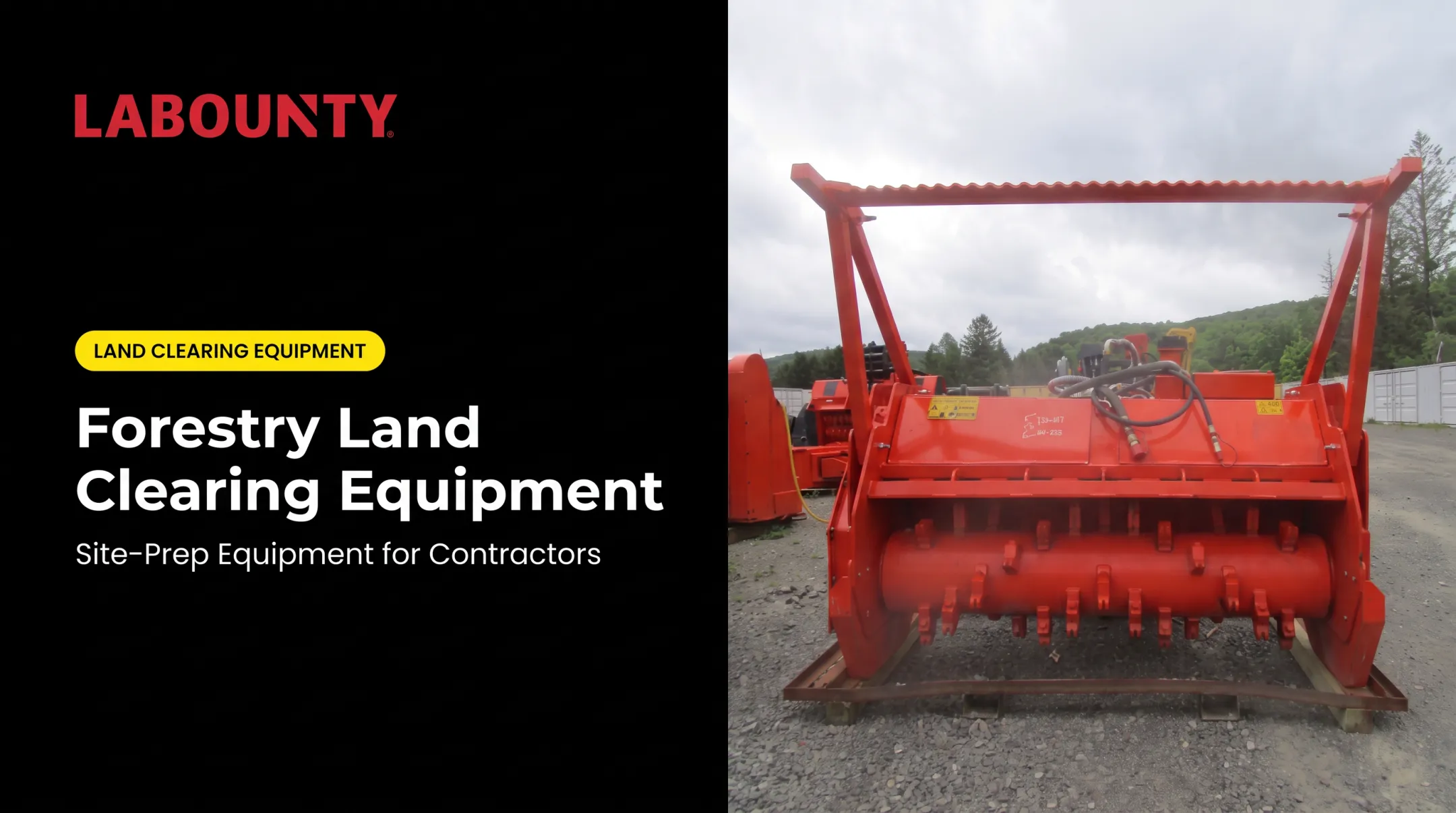
Rotary cutters handle tall grass, weeds, vines, brush, and smaller saplings. Forestry mulchers step up to denser woody vegetation and process material into finer mulch instead of leaving cut stems behind.
Cutting capacity varies widely by model. Bush Hog's BH110-series single-spindle cutters are rated for roughly 1-inch material, while Woods' BB60.50 handles up to 3-inch stems with a minimum 30 PTO horsepower requirement.
FAE's UML/LOW forestry mulcher is built for material up to 8 inches and needs 60-110 tractor horsepower. Don't generalize from "rotary cutter" or "brush cutter" as a category. Check the manufacturer-rated diameter for the specific model.
Rear PTO vs. hydraulic mount:
- A rear PTO rotary cutter draws power directly from the tractor's PTO shaft, so PTO horsepower (not engine horsepower) is the number that matters.
- A hydraulic loader- or excavator-mounted mulcher instead depends on hydraulic flow, attachment weight, and the mount interface: a completely different set of specs to verify.
The catch with every cutting attachment: it removes what's above ground, not what's below it. Roots, stumps, and buried rock survive the pass untouched, which is why a second attachment usually follows.

Comparison snapshot:
| Attachment | Best for | Tractor connection | Key limitation |
|---|---|---|---|
| Rotary cutter | Grass, weeds, brush, small saplings | Rear PTO | Won't touch roots or dense woody material beyond rating |
| Forestry mulcher | Dense brush, woody stems, finer processing | PTO or hydraulic mount | Higher hp/flow requirement; heavier attachment |
For contractors clearing wooded lots with a skid steer instead of a rear-PTO tractor, forestry mulching attachments cover similar ground with a different mount. A 6-foot-wide unit rated around 2,585 lbs is a common skid-steer option when your carrier isn't a traditional tractor.
Root Rake Grapple or Grapple Bucket
Once vegetation is cut, something has to move it. That's the grapple's job.
An open-tine root rake grapple pulls, clamps, sorts, and transports brush, logs, roots, and storm debris while letting loose soil fall through the tines. This keeps you from hauling dirt along with debris you're trying to clear.
What to check before buying:
- Front-end loader compatibility and quick-attach interface
- Loader's own lift capacity — not just the grapple's rated weight
- Hydraulic connections, including whether a third-function circuit is required
- Coupler type: universal skid-steer-style, Euro/Global, or manufacturer-specific
John Deere's MG20F mechanical grapple, for example, is rated at 1,200 lbs and operates without needing a third hydraulic function. That detail changes what your loader needs to support it. Hydraulic grapples typically need that extra circuit plumbed in.
Grapple vs. solid bucket:
A grapple beats a bucket for irregular debris like tangled brush, cut logs, and root balls because it clamps and holds instead of just scooping. A solid bucket, on the other hand, works better for loose soil, aggregate, and backfilling (material with no odd shapes to grip).
Comparison snapshot:
- Best materials: brush piles, logs, root balls, storm debris
- Hydraulic check: confirm third-function availability if the grapple requires it
- Advantage: keeps soil separated from debris during cleanup
- Risk: unstable loads and hidden objects inside brush piles can shift unexpectedly under load
Root Rake, Tree Puller, or Stump Grinder
Cutting vegetation doesn't remove what's underground. That's a separate job, and three different attachments handle it in three different ways.
- Root rakes comb or loosen surface roots and brush without fully excavating the root system.
- Tree pullers clamp onto smaller trees or posts and pull the whole root structure out of the ground.
- Stump grinders reduce what's left of a stump below or near grade, leaving the root system in place underground.
Land Pride's GR15-series grinder, for example, grinds to 10 inches below ground. Its CTP10 compact tree puller pulls shrubs and saplings with roots intact. Those are different outcomes for different jobs.
Confirm the specific model fits before you commit:
- Tree diameter limit
- Stump size rating and digging depth
- Carrier weight requirement
- Hydraulic flow
Pulling vs. grinding — the disturbance trade-off:
Uprooting disturbs more soil than grinding. That matters near utilities, structures, drainage systems, or slopes prone to erosion. Grinding leaves the root ball in place, which stabilizes the soil better but can leave regrowth risk with certain species.
| Situation | Better fit |
|---|---|
| Exposed surface roots, no full removal needed | Root rake |
| Smaller trees or posts, full removal wanted | Tree puller |
| Established stump, soil disturbance is a concern | Stump grinder |
Before pulling or grinding near a property line, septic system, or utility easement, contact 811 through your state's one-call notification service. It's free, and it's the fastest way to avoid an expensive mistake underground.
Rock Bucket or Rock Rake
Rocks left on a cleared site interfere with grading, seeding, and future equipment traffic. Rock buckets scoop and carry loose rock; rock rakes comb and windrow it. Both separate stone from soil and control how much dirt moves with the load.
Tine spacing determines how much soil passes through versus how much rock gets retained. Wider spacing lets more soil fall through; tighter spacing catches more debris but retains more soil too. A 66-inch rock bucket with 2- or 3-inch tine spacing behaves differently depending on which configuration you choose. Check the spec sheet, not just the width.
Surface collection vs. buried rock:
These attachments are built for surface rock, not embedded boulders. If rock is buried or requires breaking apart before it can be moved, a hydraulic breaker, ripper, or excavator is the more appropriate tool. Trying to pry an embedded rock loose with a rock bucket risks damaging the attachment or overloading the tractor's front end.

Checks before use:
- Front-loader capacity rated against the bucket's operating weight, not just its size
- Tine durability for the rock density you're handling
- Bucket width matched to loader capacity, not maximized for coverage
- Stay within the tractor's rated lift limits; an oversized rock can tip the machine forward fast
Comparison snapshot:
- Best use: loose surface rock and coarse debris collection
- Mounting: front loader, quick-attach compatible
- Soil-screening capability: depends entirely on tine spacing
- Avoid using for: buried, oversized, or embedded rock requiring excavation
Box Blade, Scarifier, or Landscape Rake
Once vegetation, roots, and rocks are gone, the site still needs finishing. These three attachments prepare cleared ground for seeding, construction, or vehicle access.
- Scarifiers break up compacted layers so water and roots can penetrate again.
- Box blades move and grade material, filling shallow ruts and leveling uneven ground.
- Landscape rakes handle final cleanup, pulling loose debris and smoothing the surface.
A common two-pass approach: scarify compacted high spots first, then follow with a landscape rake to gather what got loosened and refine the finish. Land Pride's BB12 box scraper, as one example, uses adjustable scarifier shanks with three depth notches, so operators can dial in aggressiveness rather than forcing a single fixed setting.
Before you buy or operate:
- Confirm three-point hitch category (Category 1 is common for smaller tractors)
- Check implement weight against the tractor's lift capacity
- Watch for wheel spin or shank overload — that's a sign to reduce depth, not push harder
- Limit how much topsoil you move in one pass to cut erosion risk on slopes
Comparison snapshot:
| Implement | Best finishing task | Ground condition | Expected result |
|---|---|---|---|
| Scarifier | Breaking compacted soil | Hard-packed, compacted | Loosened surface ready for grading |
| Box blade | Grading and rut-filling | Uneven, rutted | Leveled surface |
| Landscape rake | Final debris cleanup | Loosened, debris-covered | Smooth, seed-ready surface |
How We Chose the Best Tractor Attachments
Match the attachment to the material, the tractor, and the site. Size ratings and marketing claims matter only after that fit is clear.
Material and job stage first. Weeds and grass, woody brush, standing trees, roots and stumps, rocks, debris handling, and final grading are seven distinct problems. An attachment rated for one doesn't automatically solve another.
Tractor compatibility (verify, don't assume):
- Engine horsepower vs. PTO horsepower (they're not the same number)
- Hydraulic flow and pressure for hydraulic-driven attachments
- Loader lift capacity, separate from the attachment's own weight rating
- Three-point hitch category and quick-attach standard
- Required ballast to keep the tractor stable under load
Site risk assessment. Slopes, wet or unstable soil, concealed utilities, fences, overhead branches, loose rock, and limited operator visibility all change what's safe to run. Walk the site and confirm utility locations before any root-pulling or scarifying begins.

Ownership cost beyond the price tag. Purchase or rental cost is one line item. Wear parts, tooth replacement, hydraulic hose condition, maintenance access, parts availability, and operator training all affect uptime long after the sale closes.
For contractors running mixed fleets, mismatched mounts and pins are a common bottleneck. EFI Demolition Equipment builds custom mounts and pins for unusual carrier interfaces when a standard attachment will not line up.
Fitment support, inspection, and repair matter most when a rental deadline or job schedule leaves no room for guesswork. Confirm tractor-specific availability before assuming a given attachment fits your carrier.
Conclusion
There's no single best land-clearing attachment. The right choice depends on your material, terrain, tractor, and desired finish.
Plan the work in stages:
- Cut or mulch vegetation
- Remove roots or rocks
- Gather debris
- Grade the ground into its final shape
Before you commit to any attachment, verify the manufacturer's specifications against your actual tractor. Don't skip the safety steps either: utility locates, slope assessment, and ballast checks all cost less than a mistake.
When a standard configuration doesn't fit your carrier or your job's unusual demands, EFI Demolition Equipment can help with attachment-fitment guidance, custom mounts and pins, and equipment support to keep the project moving.
Frequently Asked Questions
What is the best tractor attachment for clearing land?
It depends on the material and workflow. Use a brush cutter or mulcher for standing vegetation, a grapple or root rake for debris and roots, and a grading attachment to finish the surface once clearing is done.
What is the best tractor attachment for clearing weeds?
A rotary cutter handles tall weeds and grass in a single pass. You may still need a landscape rake or grapple afterward to clear cut material, and a follow-up mowing schedule to manage regrowth.
What type of tractor attachment can I use to remove rocks?
Rock buckets and rock rakes collect surface rocks and coarse debris. Buried or oversized rocks usually require a ripper, hydraulic breaker, excavator, or a professional operator instead.
How do I know whether a tractor can handle a land-clearing attachment?
Check PTO horsepower, hydraulic flow, loader lift capacity, attachment weight, hitch or coupler compatibility, and required ballast against the manufacturer's rated operating limits. Never assume engine horsepower equals PTO horsepower.
Is a grapple or brush cutter better for clearing brush?
They do different jobs. A brush cutter cuts standing brush; a grapple gathers and transports what's already been cut, including logs and roots. Most clearing jobs use both, at different stages.
What tractor attachment removes tree stumps and roots?
Tree pullers extract smaller trees with roots intact, root rakes comb loose surface roots, and stump grinders reduce established stumps in place. The safest choice depends on stump size, nearby utilities, and how much soil disturbance the site can tolerate.