
Go too small and you're fighting shallow digging depth, weak breakout force, and slow cycle times. Go too big and you run into access problems, trailer weight limits, ground damage, and higher rental or fuel costs for capacity you never use.
This guide breaks down Kubota's U-series and KX-series excavators by practical weight class, covers the specs that actually matter (operating weight, reach, tail swing, lifting capacity), and gives you a selection process that starts with the job, not the brochure.
Key Takeaways
- Match size to operating weight, width, dig depth, reach, tail swing, and attachments—not tonnage alone
- U-series favor tight or zero tail swing; KX-series deliver conventional swing and stronger digging
- Small models fit landscaping and tight access; mid-size cover construction; larger units handle heavy excavation
- Confirm specs, trailer capacity, and attachment compatibility before renting or buying
What Are Kubota Mini Excavators?
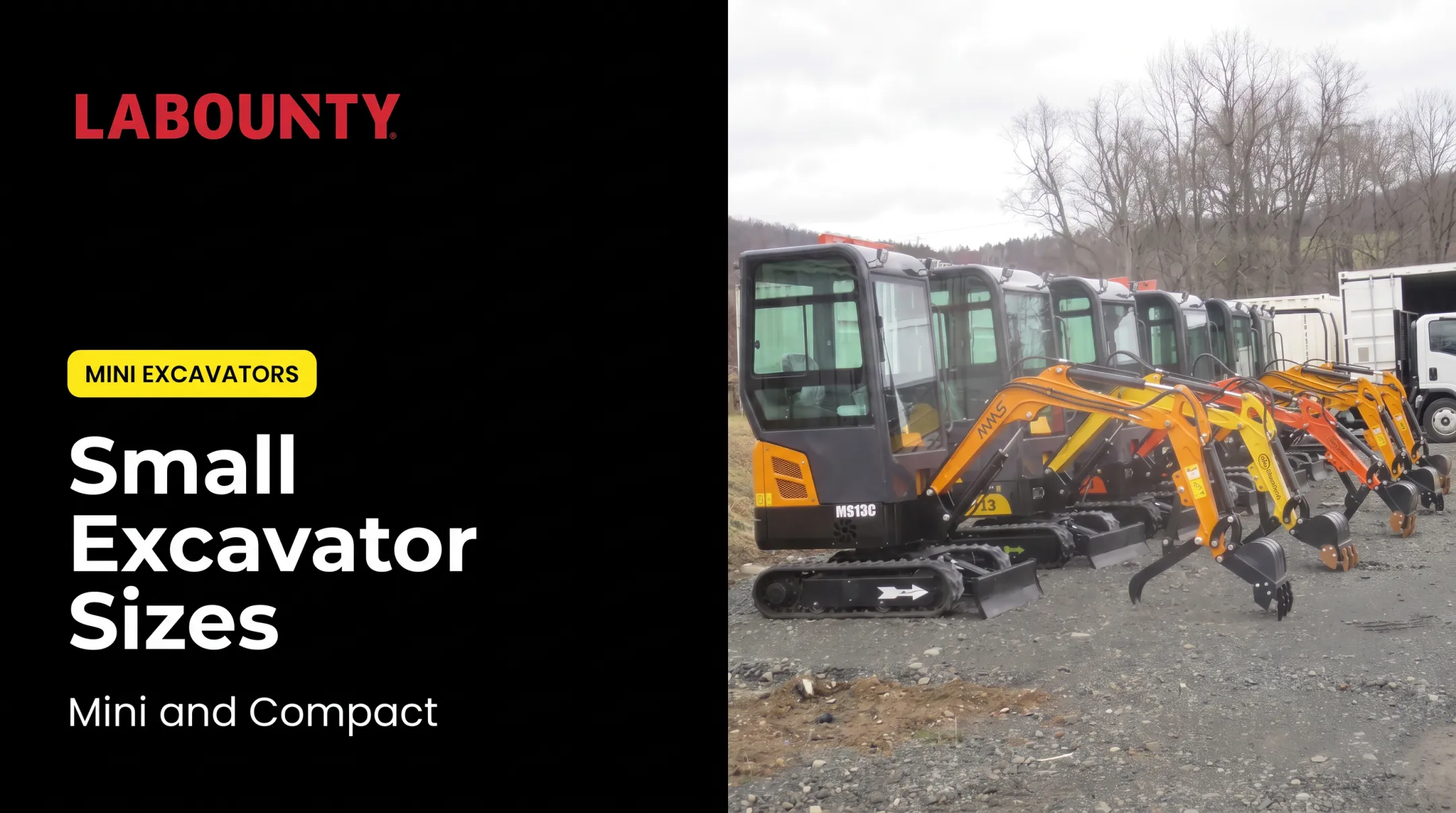
A Kubota mini excavator is a compact tracked machine used for digging, trenching, grading, landscaping, utility work, and demolition. It also runs attachment-driven tasks like breaking and material handling. "Mini" is a loose term here. Kubota's range spans machines with wildly different operating weights, widths, digging depths, and engine outputs.
Two model families matter most for this comparison:
- U-series: Compact or zero tail-swing designs for work close to buildings, fences, and roadways
- KX-series: Conventional tail swing when digging force, reach, and productivity matter more than tight clearance
Size decisions show up in concrete ways on a jobsite:
- Can the machine fit through the gate?
- Can it work flush against a wall without the counterweight swinging into it?
- Can it reach the bottom of your trench?
- Will it load onto your trailer without exceeding payload limits?
Because Kubota updates model configurations and specifications over time, always confirm the current model year and configuration using Kubota's official U.S. product literature before finalizing a purchase or rental.
Different Kubota Mini Excavator Sizes
Weight-class labels (1-2 ton, 2-4 ton, and so on) are a useful shorthand for comparing models, but they're approximate groupings, not an official classification system. Bands overlap, and two machines in the "same" class can differ meaningfully in reach, swing, and lift. Treat the numbers below as a starting point, then check the specific machine's official spec sheet.
Small Kubota Mini Excavators (Roughly 1-2 Tons)
This class includes the K008-series, U10-series, U17, and comparable small KX models. These machines are built for narrow access and minimal ground disturbance.
Strengths:
- Fits through standard residential gates and tight side yards
- Low ground pressure, which matters on finished lawns and landscaping
- Easy to transport on a standard trailer
- Well-suited to irrigation work, light utility trenching, stump removal, and small demolition tasks
Trade-offs: Shallower digging depth and reduced lifting or breakout force compared to larger machines.
Kubota's K008-5 retracts to just 2 ft 4 in wide, while the U10-5 narrows to 2 ft 6 in. Both widen their tracks for stability once working, so gate width and working pad width are two separate measurements.
The U10-5's maximum dig depth tops out at 5 ft 11 in, according to Kubota's K008-5/U10-5 brochure.
This class is a poor fit for deep utility trenches, hard rock, frequent heavy lifting, or any job requiring a larger hydraulic breaker. Before mounting any attachment, confirm it's approved for the specific model.
Medium Kubota Mini Excavators (Roughly 2-4 Tons)
Representative models include the U27, U35, KX030, and KX033. This range is often the sweet spot for residential construction, utility installation, drainage, foundations, grading, and light commercial work.
These machines offer noticeably more reach, digging depth, and attachment capacity than the ultra-compact class, though they typically require wider access routes and heavier transport equipment.
For example, the KX033-4 with a standard arm publishes a 10 ft 6 in maximum dig depth, while the extendable-arm version pushes that to 12 ft 2 in—worth it when the trench needs that extra depth.
Choosing between a U-series and KX-series machine here comes down to:
- Access constraints - tight rear clearance favors the tight-swing U-series
- Soil conditions - harder ground benefits from the conventional-swing KX's stability and breakout force
- Cycle time needs - faster material movement often favors the extra reach of extendable-arm configurations
Larger Compact Excavators (Roughly 4-6 Tons)
This class covers the KX040, U48, U55, and KX057, with each model offering greater digging force, stability, and lifting ability than the mid-size range.
| Model | Width | Max dig depth | Primary auxiliary flow |
|---|---|---|---|
| KX040-5 | 5 ft 7.3 in | 11 ft 2.3 in | 17.2 gpm |
| U48-5 | 6 ft 5 in | 10 ft 8 in | 17.2 gpm |
| U55-5 | 6 ft 5 in | 11 ft 11 in | 19.8 gpm |
| KX057-5 | 6 ft 5 in (rubber) | 12 ft 9 in | 19.8 gpm |
Width figures reflect baseline configurations; optional blades can add several inches.
These machines handle deeper trenching, foundation work, larger landscaping projects, and material handling, plus selected demolition work with the right breaker or pulverizer attached.
The trade-off is real: more transport weight, higher ground pressure, reduced site access, and higher operating costs. Verify the jobsite can actually accommodate a machine this size before committing to it.
Large Kubota Compact Excavators (Around 8 Tons)
The KX080-5 sits at the top of Kubota's compact excavator range, built for deep excavation, substantial site prep, heavier material handling, and demolition work where a full-size excavator would be overkill but a smaller mini excavator can't keep up.
Kubota's 2026 lineup lists the KX080-5 at 18,365 lb operating weight and 7 ft 2.6 in width, with a published maximum dig depth of 15 ft 1.1 in and 66.6 gross hp. Standard and angle-blade configurations shift both weight and width, so confirm the exact build before planning transport.
Here's the critical point: an "8-ton" label tells you almost nothing about what the machine can actually lift. The KX080-5 operator manual shows a front-lift, blade-down capacity of 7,200 lb at a 12-foot radius, ground-line lift point, but only 3,300 lb over the side at that same position.

Lift capacity swings hard depending on direction, radius, and height. Always check the official load chart for your specific configuration before lifting pipe, placing materials, or handling demolition debris.
How to Choose the Right Kubota Mini Excavator Size
Start with the job, not the model name. Before comparing excavators, nail down the required trench depth, digging force, reach, production rate, and any lifting or demolition tasks involved.
Match the machine to the jobsite:
- Measure gates, driveways, access routes, overhead obstructions, and turning areas
- Assess soil stability, slopes, turf sensitivity, underground hazards, and whether standard rubber tracks suit the ground
- Compare the machine's full operating weight (not just the base spec) against your trailer capacity, tow vehicle rating, and tie-down requirements
Match attachments and hydraulics:
A breaker, pulverizer, grapple, or auger has to match the excavator's hydraulic flow and pressure, plus the pin and coupler dimensions.
Attachment costs vary widely by size and spec:
- Hydraulic hammers: typically $10,800 to $42,000
- Screening or crushing buckets: $9,400 to $35,000
Verify manufacturer approval for any attachment before mounting it.
This is where a dealer that carries attachments across brands becomes genuinely useful. EFI Demolition Equipment stocks hammers, shears, pulverizers, grapples, and augers, and fabricates custom mounts and pins to fit excavators across the weight spectrum.
That doesn't mean every Kubota model sits in inventory. It does mean attachment selection and custom fitment don't have to be a separate headache once you've picked your excavator.
A simple decision path:
- Choose the smallest model that meets your required access and ground-impact limits
- Move up a size class only if the work demands greater depth, faster cycles, more lifting stability, or sustained production
- Confirm the official load chart before any lifting, pipe-placement, or debris-handling task
- Request a current equipment inspection, service history, delivery estimate, and full pricing before committing

What to Check Before Finalizing a Size
Don't default to the most powerful model available. A larger excavator can create access, transport, and cost problems you don't need to take on.
- Compare more than weight. Digging depth, reach, width, tail swing, breakout force, and auxiliary hydraulics all matter independently.
- Check what's included in the quoted weight. Cab, counterweight, blade, tracks, fluids, and attachments can all shift the number, so compare apples to apples.
- Confirm specs directly with current Kubota documentation. Model names, dimensions, and available equipment can vary by model year.
- Factor in long-term support. Parts availability, operator training, inspection records, and emergency repair access can matter as much as rental or purchase price.
A machine that's 500 lb lighter than the trailer rating on paper can still exceed it once you add the bucket, full fuel tank, and operator gear. Weigh the actual configuration, not the brochure number.

Conclusion
Kubota's mini excavator range spans ultra-compact machines built for tight residential access all the way up to 8-ton compact excavators ready for heavy excavation and demolition. None of these classes is universally "better." The right choice depends on your full job profile:
- Site dimensions and ground conditions
- Transport capacity and required digging depth
- Attachment needs and the lifting chart for your configuration
Compare current specifications before you commit to a model. If you need help sourcing attachments, arranging a rental, confirming attachment fit, or getting equipment delivered, reach out to EFI Demolition Equipment at +1 (315) 440-2762.
Frequently Asked Questions
What is the difference between Kubota U-series and KX-series excavators?
U-series models emphasize zero or tight tail-swing for work close to obstacles. KX-series models use conventional tail swing and typically deliver stronger digging performance. Confirm specs for your exact model year.
What is the lifting capacity of an 8-ton Kubota excavator?
It varies significantly by boom position, radius, lift direction, and configuration. For example, one published chart shows 7,200 lb over the front but only 3,300 lb over the side at the same radius. Always check the official load chart for your exact machine.
What is the operating weight of the Kubota U17 excavator?
Kubota's current U17-5 brochure lists 3,170 lb for a ROPS canopy, rubber-track configuration without a bucket. Cab, track, and attachment changes will affect the final transport weight.
What is the width of the Kubota 57 excavator?
That usually means the KX057-5, listed at 6 ft 5 in on rubber tracks and 6 ft 6 in on steel tracks. Factor in the blade option separately—it can add width and affect site access.